Home › Getaways › The Colour Villages

The Colour VillagesBy carRowanwindwhistler — CC BY-SA 3.0 (Wikimedia Commons)

The Colour Villages

Sierra de Ayllón, Segovia, Spain · Spain

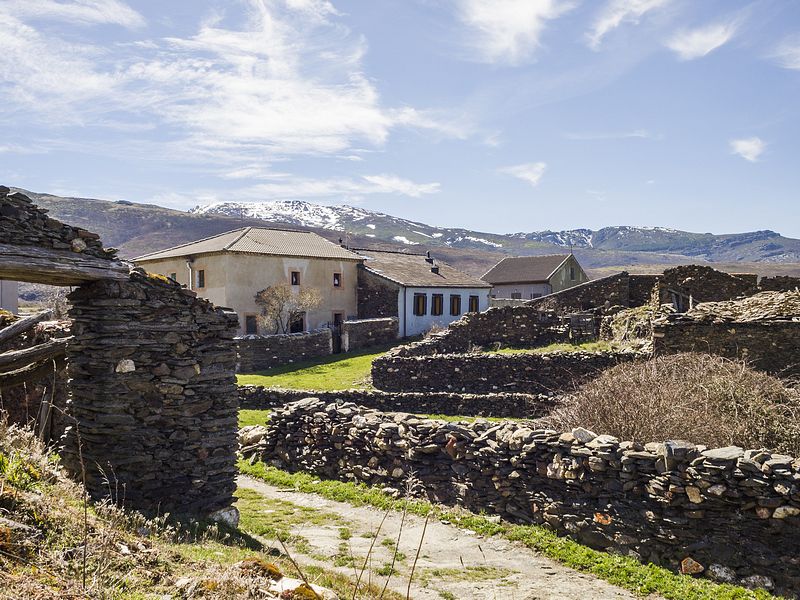
Eight tiny villages on the flank of the Sierra de Ayllón, each a different colour: two yellow ones of quartzite, four black ones of slate and two red ones of iron-bearing sandstone. The reason is geological and domestic at once: for centuries people built with whatever stone was nearest, and the bedrock changes several times in barely twenty kilometres. Between them all they do not reach a hundred registered inhabitants, and they lie two hours from Madrid.

2 days1 night80 km10 stopsBest season: Autumn, for the oak woods and the passing cranes, and spring. In summer the contrast of colours reads worse under the high midday sun: go first thing or late. In winter it can snow and some of the side roads get difficult.

Day 1 · Yellows and reds

Riaza, Alquité, Martín Muñoz, Villacorta and Madriguera · 32 km

RiazaLuis Rogelio HM — CC BY-SA 2.0 (Wikimedia Commons)

Riaza

history

The large town of the region and the natural gateway to the route. Its main square is elliptical and arcaded, and it still works as a bullring: the entrances are boarded up and the bulls run right there. It belonged to the Comunidad de Villa y Tierra de Ayllón and keeps its old street layout around the square.

Tip

It is the last place with a petrol station, a supermarket and a cash machine. From here on the villages have fewer than a hundred inhabitants and there is absolutely nothing.
10 min to the next stop · 8 km

AlquitéDavidDaguerro — CC BY-SA 4.0 (Wikimedia Commons)

Alquité

heritage

The first of the yellow villages and the gateway to the colour route. Its walls are of quartzite, a pale rock that shifts from yellow to ochre depending on the light. It stands at one thousand two hundred and thirty metres, and from here you see the range and the plain at once.

Tip

Look closely at the stone: quartzite splits into irregular slabs and glints slightly in the sun, because it holds quartz crystals. That is what gives the golden tone.

5 min to the next stop · 2 km

Martín Muñoz de AyllónDavidDaguerro de Madrid — CC BY-SA 4.0 (Wikimedia Commons)

Martín Muñoz de Ayllón

history

The second yellow village, at one thousand two hundred and seventy metres. It had slate quarries whose stone was used to roof the Royal Palace of La Granja and to floor Segovia cathedral: the material for two of the province's most important buildings came from here.

Tip

Its name, by tradition, comes from a general of El Cid mentioned in the Cantar. And there is a flour mill on the river that can be seen from outside.

5 min to the next stop · 6 km

VillacortaArkis1000 — CC BY-SA 4.0 (Wikimedia Commons)

Villacorta

heritage

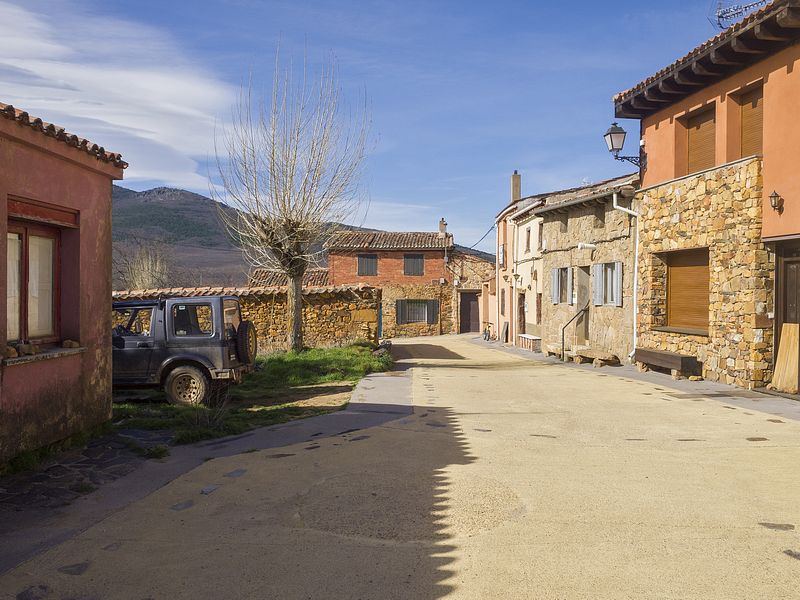
The first of the two red villages, at eleven hundred metres and the lowest of the colour villages. Here the stone changes abruptly: iron-bearing sandstones and iron-rich clays that stain the walls an earthy red unlike anything in the previous villages.

Tip

In Villacorta, besides the church, there is the chapel of San Roque: a five-minute stop that almost nobody makes.

5 min to the next stop · 3 km

MadrigueraRowanwindwhistler — CC BY-SA 3.0 (Wikimedia Commons)

Madriguera

culture

The reddest of them all and the most photographed on the route. On the outskirts lie the remains of an abandoned kaolin and graphite mine that gave the village work, and in the centre the church of San Pedro, large for the size of the village, its walls the same red as the houses.

Tip

The church of San Pedro, red like everything else, is the image of Madriguera. And the village has been slowly restored in recent years, so here there are a couple of guesthouses and some life at weekends.

Day 2 · The four blacks and the finish on the plain

Becerril, Serracín, El Muyo, El Negredo and Ayllón · 48 km

BecerrilDavidDaguerro de Madrid — CC BY-SA 4.0 (Wikimedia Commons)

Becerril

heritage

The first of the four black villages, at one thousand two hundred and forty metres. Here slate replaces quartzite and iron, and the change of colour is so abrupt it is hard to believe Alquité is ten minutes away. It sits at the end of a side road, so you do not pass through it: you have to go.

Tip

It is among the quietest on the route and has good views of the valley from the upper part of the village. Almost nobody turns off to come here.

10 min to the next stop · 3 km

SerracínVickybol — CC BY-SA 4.0 (Wikimedia Commons)

Serracín

heritage

A black village of barely twenty houses, with the slate laid in very thin horizontal slabs. It stands at one thousand two hundred and thirty-seven metres, ringed by oak woods that change everything in autumn.

Tip

It has one of the most uniform slate ensembles of them all. Between Serracín and El Muyo there are three kilometres worth walking if you have the morning.

5 min to the next stop · 3 km

El Muyomanuel from Madrid, España — CC BY-SA 2.0 (Wikimedia Commons)

El Muyo

viewpoints

The highest of the eight, at one thousand two hundred and eighty-five metres, and for many the prettiest. It has been fully restored in slate and can be walked end to end in twenty minutes, but it is the one that best keeps the look they all had before they were abandoned.

Tip

In autumn and winter this area is on the cranes' flight path: if you hear the call, look up. They travel in long skeins towards the southern lagoons.

10 min to the next stop · 7 km

El NegredoRowanwindwhistler — CC BY-SA 3.0 (Wikimedia Commons)

El Negredo

history

The last of the black villages and the lowest of the four, at one thousand one hundred and nineteen metres. Its church of Nuestra Señora del Vallehermoso is Romanesque in origin and keeps a Renaissance portico that clashes, agreeably, with the humility of the rest of the village.

Tip

It is the village fewest people go down to, because it lies a little apart and comes at the end of the route. Which is exactly why it is usually empty.

20 min to the next stop · 17 km

AyllónLuis Rogelio HM — CC BY-SA 2.0 (Wikimedia Commons)

Ayllón

history

The end of the route and the other large town of the region, already down on the plain. Here the red sandstone reappears, but on grand buildings: the 15th-century Contreras palace with its Gothic front, and the wall arch that opens onto the arcaded main square.

Tip

This is where to eat when the route is done, because it has proper restaurants. And here you see the same red as Madriguera applied to a palace instead of a village house.

This getaway is in the app, day by day, with every stop on the map, the drives between them and where to sleep, and the option to save it for when there is no signal.

Open in JourGuide

Getaways