Home › Getaways › The Cotswolds

The CotswoldsBy carPhotograph by Mike Peel (www.mikepeel.net). — CC BY-SA 4.0 (Wikimedia Commons)

The Cotswolds

Gloucestershire and Oxfordshire, England · United Kingdom

More than a hundred honey-coloured limestone villages spread across six English counties, and they all tell the same story: in the late Middle Ages the wool from this region was sold all over Europe, the merchants grew enormously rich and built churches out of all proportion to their villages. Then the trade moved north, the money ran out and almost nothing was built here again. That is why they look the same: not through preservation, but because nobody could afford to change them.

3 days2 nights66 km8 stopsBest season: May to September, with the gardens in bloom and light until late. May and September are the best: the same green and far fewer people than in July and August. In winter it gets dark at four and many village pubs cut their hours.

Day 1 · The wool churches

Chipping Campden and Broadway · 24 km

Chipping CampdenSarah Stierch — CC BY 3.0 (Wikimedia Commons)

Chipping Campden

history

St James's church is enormous for a village of two thousand, and that disproportion explains everything: the wool merchants paid for it in the 15th century, when the wool from this region was sold all over Europe. It is considered the finest Perpendicular Gothic church in the Cotswolds. On the high street stands the covered market hall of 1627.

Tip

The Cotswold Way starts here, a hundred-and-sixty-kilometre path to Bath. Even if you do not walk it, the first stretch out of the village gives you a view over the valley in twenty minutes.

15 min to the next stop · 12 km

Broadway and its towerMrfinch — CC BY-SA 3.0 (Wikimedia Commons)

Broadway and its tower

viewpoints

A wide, long high street lined with chestnut trees and honey-coloured stone houses. And on top of the hill, Broadway Tower: a neo-Gothic folly an earl had built in 1798 so his wife could see it from their house, twenty-five kilometres away.

Tip

From the tower you can see more than a dozen counties on a clear day. The drive up is short but the Fish Hill road is steep and narrow.

Day 2 · Stocks, streams and five bridges

Stow, Lower Slaughter and Bourton · 15 km

Stow-on-the-WoldCharlesdrakew — Public domain (Wikimedia Commons)

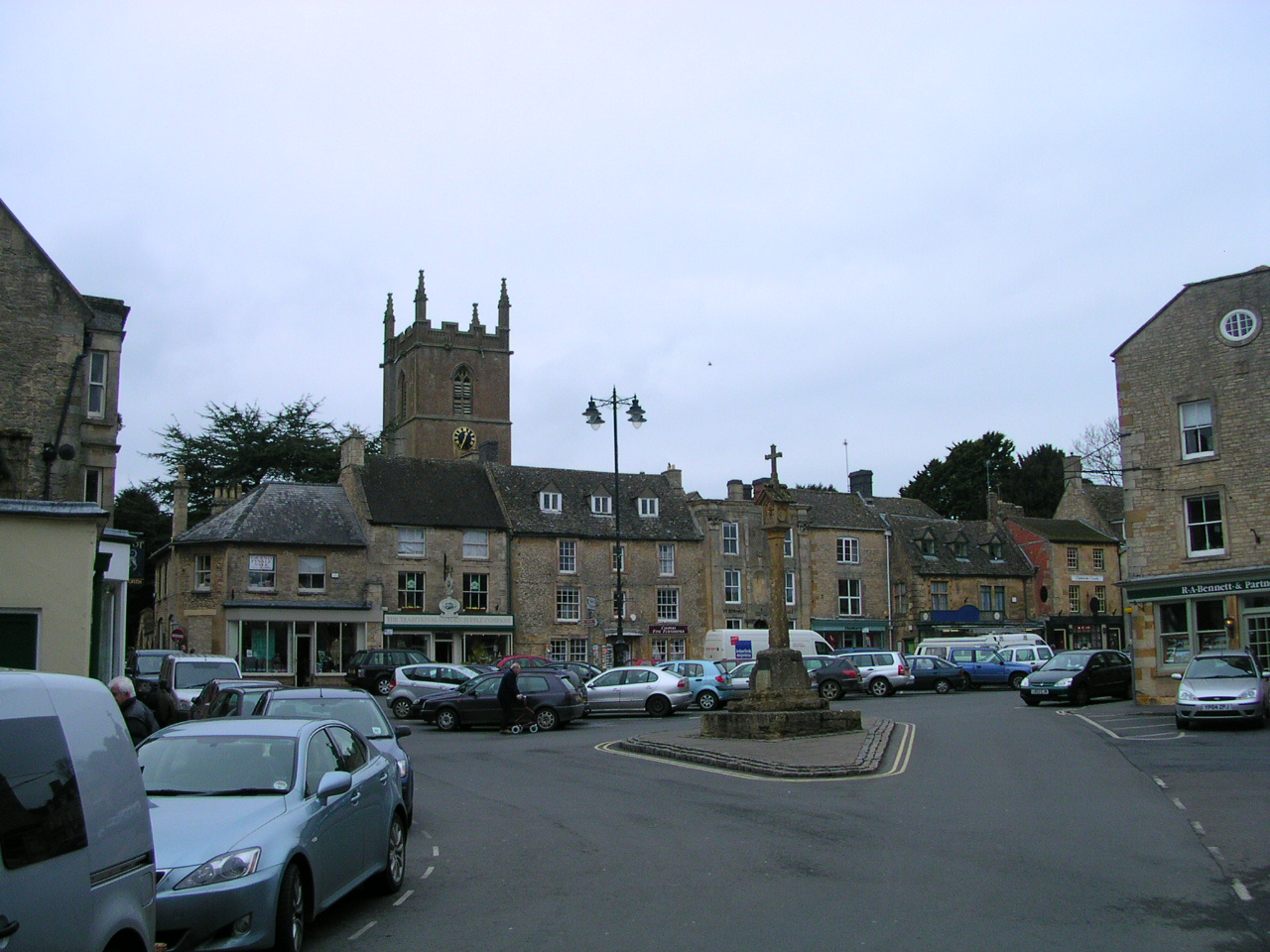
Stow-on-the-Wold

culture

The highest sizeable town in the Cotswolds, at around two hundred and forty metres, at a crossroads of ancient roads. On the market square the stocks where the condemned were displayed still stand, and the north door of St Edward's church has two ancient yews embracing it on either side.

Tip

That yew door is the image doing the rounds on half the internet. It is behind the church, not on the main front: almost everyone walks straight past looking for it.

10 min to the next stop · 5 km

Lower SlaughterSaffron Blaze — CC BY-SA 3.0 (Wikimedia Commons)

Lower Slaughter

heritage

A tiny village crossed by the River Eye, with two stone footbridges and a 19th-century brick mill that deliberately clashes with everything else. The name has nothing to do with killing: it comes from Old English slohtre, meaning a muddy place.

Tip

There is no village car park: you leave the car on the street considerately and walk in. It is a hundred houses and takes half an hour, but it is one of the few places with no shops and no coaches.

5 min to the next stop · 3 km

Bourton-on-the-WaterBin im Garten — CC BY-SA 3.0 (Wikimedia Commons)

Bourton-on-the-Water

culture

The river Windrush runs right through the middle of the village, wide and shallow, with five low stone bridges and lawns on both banks. They call it the Venice of the Cotswolds, though the comparison is generous, and it is the most visited village in the region.

Tip

Do not confuse it with Bourton-on-the-Hill, ten kilometres away: put the full name into the sat nav. And park the moment you arrive, because by mid-morning there is no space left.

Day 3 · From the village nobody visits to the prettiest in England

Northleach, Bibury and Burford · 27 km

NorthleachColin Smith — CC BY-SA 2.0 (Wikimedia Commons)

Northleach

history

The village almost nobody visits, home to the second great wool church: St Peter and St Paul, raised in the 15th century with merchants' money. Inside are brass memorials with the figures of those traders, each with his sheep and his woolsacks at his feet.

Tip

Those brasses are among the finest in England and there is no queue to see them here. Coming from Stow it is a twenty-minute detour that almost nobody makes.

15 min to the next stop · 10 km

BiburySaffron Blaze — CC BY-SA 3.0 (Wikimedia Commons)

Bibury

heritage

William Morris called it the most beautiful village in England and the label stuck. It is in fact two villages, Bibury and Arlington, split by the river Coln. What you come to see is Arlington Row: a terrace of 14th-century stone houses, built as a wool store and turned into weavers' cottages three centuries later.

Tip

Important: Bibury has NO public car park. You park on the road very carefully or in the trout farm's car park if it is open to visitors. It is the village's biggest problem and it pays to arrive early.

15 min to the next stop · 16 km

BurfordEttlz at English Wikipedia — CC BY-SA 3.0 (Wikimedia Commons)

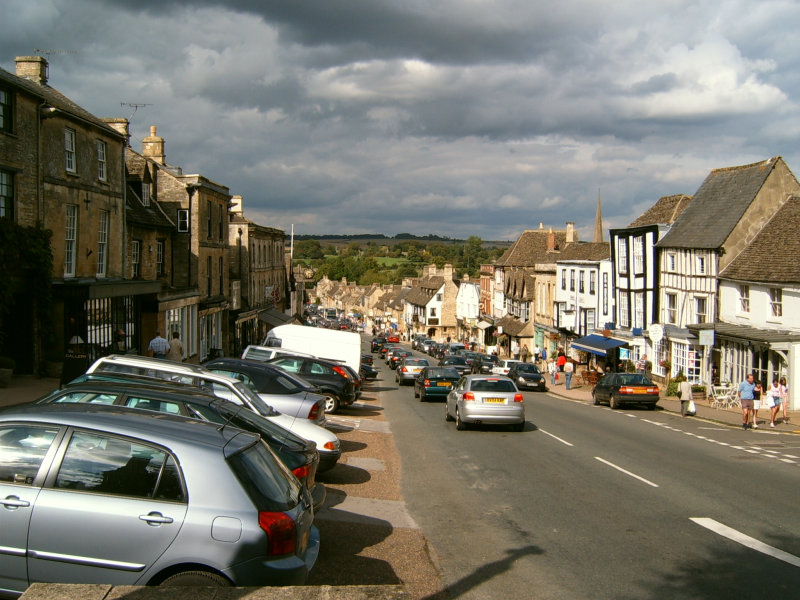
Burford

heritage

A long high street sloping down to a medieval bridge over the Windrush, with houses of every period on both sides: 15th-century timber, 17th-century stone, Georgian brick. It is known as the gateway to the Cotswolds because this is where you enter coming from Oxford.

Tip

The council car parks here are usually free, so make the most of it and enjoy a relaxed meal before heading back.

This getaway is in the app, day by day, with every stop on the map, the drives between them and where to sleep, and the option to save it for when there is no signal.

Open in JourGuide